Sections
Components
The technical core of Mode 2: seven component groups that are not independent purchases. The frame comes first and decides most of what fits after it.
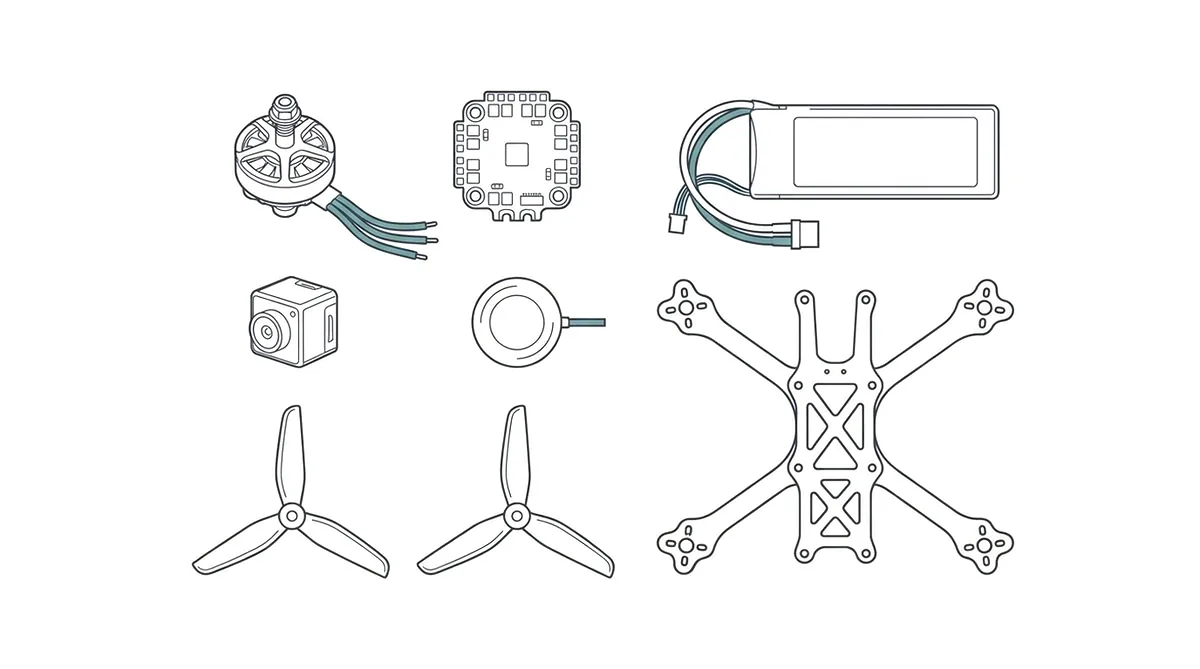
Guides in this section
- CAT-01
Frames
Size and geometry decide almost everything downstream: how much prop clearance you have, the motor mounting pattern, and the current the rest of the stack has to survive.
- CAT-02
Flight controllers
The board that reads your sticks and drives the motors. Processor, gyro, mounting pattern, and how the firmware ties it to everything bolted around it.
- CAT-03
Motors and ESCs
Stator size follows frame size, and the current rating an ESC needs follows motor size. Get the pairing wrong and something on the stack burns.
- CAT-04
Batteries
Cell count sets the voltage the motors see, and capacity trades against the weight you have to carry to get it. The last component to choose and the first to age.
- CAT-05
Video systems
Analogue or digital, and what that choice costs you in latency, range and money. The link you actually fly on.
- CAT-06
Radios and receivers
The control link, its protocol, and why the radio is the one purchase that outlives every airframe you put it in.
- CAT-07
Printed parts
TPU mounts, camera plates, and antenna guards: the parts you print yourself because no shop sells them for the exact build you have.
One choice constrains the next
The frame, the flight controller, the motors, and the ESCs are not four independent shopping decisions. They form a chain, and the first link is the frame.
Frame size sets the propeller size that fits inside the cage, and propeller size sets the motor stator size that can turn that prop without stalling or overheating. Motor manufacturers name stators with a four-digit code: the first two digits are the stator's diameter in millimetres, the last two are its height. A larger stator handles a larger prop at a given RPM, which is why frame size and motor class move together as a rule across the hobby, not only on the frames that used to be sold from this domain.
The Kilowatt, one of the frames this domain's earlier owner built and sold, shows the chain concretely: a 145 mm, unibody 3" frame specced for 13xx and 14xx motors. A 3" prop has no use for the stator a 5" racing frame is built around, and a 13xx/14xx motor could not turn that larger prop safely in the first place. Stator size then decides the current the motor draws at full throttle, which decides the continuous current rating the ESC underneath it has to survive, which decides how much the battery has to deliver on a hard punch-out. Change the frame, and the rest of the stack has to be re-derived, not carried over.
What these guides deliberately do not do
None of the seven guides in this section rank products or tell you which motor or ESC to buy. We have not bench-tested the hardware that a claim like that would need, and a recommendation without a test behind it is a guess wearing the clothes of advice.
What the guides do instead is explain the mechanism: why a number on a spec sheet matters, what constrains it, and where it interacts with the next component in the chain. Once you have settled on a frame and a motor pairing, the thrust-to-weight calculator is the next useful step. It will not tell you which motor to buy, but it will tell you whether the combination you are considering can lift what you plan to hang off it.